
Games based learning is becoming increasingly prominent in education as our digital world progresses and grows. Digital games are user centric, thus promoting the increase of problem solving strategies, creativity, collaboration and engagement (Gros, 2007). This week I will be critiquing Scratch and Kahoot.
SCRATCH!
Scratch is a block-based programming website that gives students the ability to be game designers. Game based construction learning (GBCL) refers to “an innovative learning approach that uses appropriate tools in order to allow games to be constructed to support learning and teaching” (Wilson et al., 2013, p. 588). Aligning with the notions of the pedagogical approach – constructivism, scratch allows students to construct their own interactive games through computer programming skills (Wilson et al., 2013).
A study conducted by Yukselturk and Altiok (2017, p. 799) revealed some limitations to implementing scratch in the classroom; it is essentially only appropriate for beginner programmers and does not support high resolution photos and videos nor programming codes.
KAHOOT
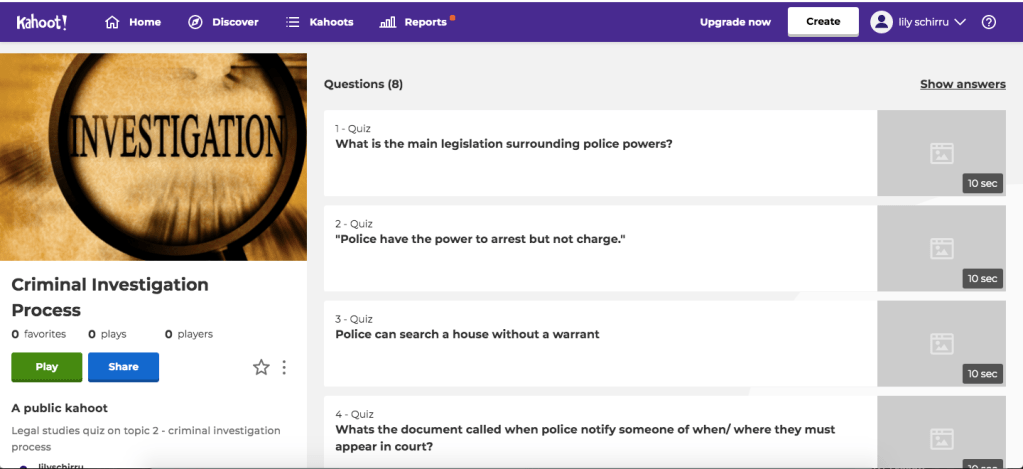
Creating a classroom atmosphere that involves critical thinking and engagement links directly to positive student learning outcomes (Dellos, 2015). With this being said, Kahoot is a game-based learning program which involves the use of quizzes developed by the user (What is Kahoot, 2020).
Advantages
Kahoot is significantly accessible as it is available on all devices (i.e. Apple and Android). Kahoot does have an app, however also accessible via a web browser. Students do not need an account to play, all that’s needed is a code that is provided by the teacher. There is a large variety of options to choose from when creating quiz questions, such as uploading videos, music or photos to encourage the engagement and learning of the students (Dellos, 2015). Kahoot is also free of charge.
Disadvantages
A limitation to kahoot can be the limited options for responses, answers can only be; yes/no, true/false or a multiple choice. From a study conducted by Plump and LaRosa (2017), several participants stated that they became stressed and felt increased pressure when trying to find the answer within a time limit. Although it can be said that the competitiveness of the game could increase motivation and engagement of the students, a lot of students will feel less inclined to participate due to the pressure of the game.
Reference list
Dellos, R. (2015). Kahoot! A digital game resource for learning. International Journal of Instructional Technology and Distance Learning, 12(4), 49-52.
Gros, B. (2007). Digital games in education: The design of games-based learning environments. Journal of research on technology in education, 40(1), 23-38.
Ke, F. (2014). An implementation of design-based learning through creating educational computer games: A case study on mathematics learning during design and computing. Computers & Education, 73, 26-39.
Plump, C. M., & LaRosa, J. (2017). Using Kahoot! in the classroom to create engagement and active learning: A game-based technology solution for eLearning novices. Management Teaching Review, 2(2), 151-158.
Kahoot! (2020). What is Kahoot! | How to play Kahoot! [Video]. https://kahoot.com/what-is-kahoot/
Scratch Team. (2017, June 20). What is Scratch? [Video]. https://www.youtube.com/watch?v=jXUZaf5D12A
Wilson, A., Hainey, T., & Connolly, T. (2012). Evaluation of computer games developed by primary school children to gauge understanding of programming concepts. Reading: Academic Conferences International Limited.
Wilson, A., Hainey, T., & Connolly, T. (2013). Development of an implementation framework for games-based construction learning using Scratch in primary education. In European Conference on Games Based Learning (p. 587). Academic Conferences International Limited.
Yukselturk, E., & Altiok, S. (2017). An investigation of the effects of programming with Scratch on the preservice IT teachers’ self‐efficacy perceptions and attitudes towards computer programming. British Journal of Educational Technology, 48(3), 789-801.
 Welcome to Lilys Blog
Hi Lily, I liked that you addressed both the advantages and disadvantages of Kahoot as a form of game-based learning. I also like how you stated that the competitiveness and time-pressure of the game may motivate some but deter others.
LikeLike
Hey Lily, thank you for an interesting blog that involves game based learning within education. The different use of two games involving digital gaming and design. I liked how you described Scratch as a constructivist approach that is appropriate for beginner programmers that develops the users learning. Also, I liked the well-thought input involving the advantages that encourage group engagement and disadvantages of limited options for responses involving Kahoot.
LikeLike