Augmented reality (AR) involves an interactive real world experience that heightens / augments real life objects through digital generated data (Kerawalla et al., 2006). AR can be linked to both real life objects, and virtual 3D objects (Carmigniani et al., 2011). Through a digitally programmed experience, AR essentially allows one to enhance their own personal perceptions of the world (Carmigniani et al., 2011).
A study by Bicen and Bal (2016) showed that AR in the classroom fosters the creativity and imagination of students. It revealed that students felt the content they were learning when mixed with AR was more enjoyable, and made the course content easier to process and understand (Bicen & Bal, 2016).
Below is an insight into one of the technological examples of AR that my group and I looked into at our tutorial.
Ikea Place
Ikeaplace is a mobile application that allows you to virtually place true scale 3D models in your own space. Along with AR, Ikea Place allows for the visual manipulation of objects; predominantly being furniture (Han & Kim, 2019). This app relies on a tablet / mobile phone through using an interactive screen, making it considerably practical in a classroom setting.
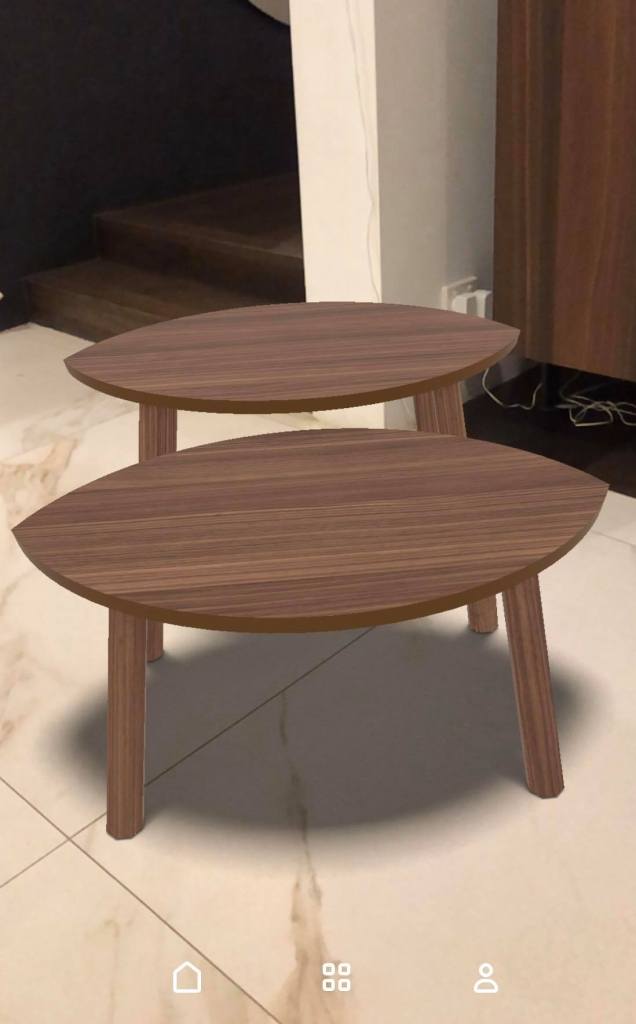
Students in today’s society have been brought up in a world surrounded by technology, thus the use of apps like Ikea Place in classrooms facilitates students centred learning by implementing pedagogies that relate on a higher level to students. Ikea place can be implemented into several subjects and stages of school. For example, a stage 6 design and technology class can find inspiration through Ikea place and see their possible future visions coming to life in real-time and real-life dimensions. Implementing this way of learning can encourage the students to be more creative as they are more willing to experiment through trial and error. One possible issue that may arise whenever tablets or devices are used in a classroom is possible room for distraction, and misuse of the device. This of course differentiates with age, however can be easily avoided with close attention and specified rules in place.
Reference list –
Bicen, H., & Bal, E. (2016). Determination of Student Opinions in Augmented Reality. World Journal on Educational Technology: Current Issues, 8(3), 205-209.
Carmigniani, J., Furht, B., Anisetti, M., Ceravolo, P., Damiani, E., & Ivkovic, M. (2011). Augmented reality technologies, systems and applications. Multimedia tools and applications, 51(1), 341-377.
Han, B., & Kim, G. J. (2019, November). 2D/3D Mixed Interface for Furniture Placement in Smartphone-based Mobile Augmented Reality. In 25th ACM Symposium on Virtual Reality Software and Technology (pp. 1-2).
IKEA. (2017, September 12). Say Hej to IKEA Place. [Video]. YouTube. https://www.youtube.com/watch?v=UudV1VdFtuQ
Kerawalla, L., Luckin, R., Seljeflot, S., & Woolard, A. (2006). “Making it real”: exploring the potential of augmented reality for teaching primary school science. Virtual reality, 10(3-4), 163-174.
 Welcome to Lilys Blog